Turning HR Compliance Into a Competitive Advantage
Most organisations treat compliance like a fire drill — react, report, repeat. But forward-thinking businesses use it as a strategic advantage.
At Irish Leadership & HR Centre (ILHRC) compliance is not about paperwork — it is about how your people actually work. Our audits go beyond policies to uncover real behaviours, identifying where compliance supports or silently hinders culture, retention, and credibility.
Our Approach: Assess. Advise. Action. Advance.
Assess: Deep-dive audits across HR processes, contracts, and workplace culture
Advise: Practical, tailored recommendations aligned to business outcomes
Action: Implementation of clear, step-by-step compliance solutions
Advance: Ongoing support to embed and sustain best practice
When compliance becomes part of your culture, it builds trust across your organisation.
Challenge-Based Learning: A Practical Approach to Real-World Skills
Challenge-Based Learning (CBL) is gaining traction across education and training as a method that connects learning with real-world problems. Rather than focusing solely on theory or predefined outcomes, CBL encourages learners to investigate challenges, develop solutions, and apply their knowledge in meaningful ways.
This approach is increasingly relevant as employers place greater value on problem-solving, collaboration, and adaptability.
What Is Challenge-Based Learning?
Challenge-Based Learning is a student-centred approach where learners work on real or simulated challenges. These challenges are often drawn from industry, society, or community issues, making the learning experience more relevant and engaging.
Instead of being given answers, learners are guided to:
Identify and define a problem
Research and analyse information
Develop and test solutions
Present outcomes and reflect on the process
The focus is on learning through doing, with outcomes shaped by the learner’s approach and findings.
Linking Learning to Real-World Contexts
One of the key strengths of CBL is its connection to real-world scenarios. This helps learners understand how their studies apply beyond the classroom.
Examples include:
Business students developing strategies for real organisations
Technology students creating solutions for practical problems
Healthcare trainees working through case-based scenarios
This relevance can increase motivation and deepen understanding.
Building Transferable Skills
CBL supports the development of skills that are widely valued across industries. These include:
Critical thinking and analysis
Problem-solving
Communication and presentation
Teamwork and collaboration
Project management
Because learners are actively involved in the process, these skills are developed in a practical and measurable way.
Encouraging Independent Learning
Unlike traditional models where content is delivered in a structured format, CBL requires learners to take responsibility for their own progress. They must research, plan, and make decisions throughout the process.
This encourages independence and helps learners become more confident in their ability to approach new challenges.
Collaboration and Group Work
Many CBL projects are completed in teams, reflecting real workplace environments. Learners must work together, share ideas, and manage tasks collectively.
This experience helps develop interpersonal skills and prepares students for professional settings where collaboration is essential.
Assessment and Outcomes
Assessment in Challenge-Based Learning often focuses on both the process and the final outcome. This may include:
Project reports or presentations
Practical demonstrations
Reflective analysis
The emphasis is on how learners approached the challenge, what they learned, and how effectively they applied their knowledge.
Challenges in Implementation
While CBL offers many benefits, it also requires careful planning. Educators need to design challenges that are realistic, relevant, and aligned with learning objectives.
Other considerations include:
Providing appropriate guidance without limiting independence
Managing group dynamics
Ensuring fair and consistent assessment
When implemented effectively, these challenges can be managed and the benefits can be significant.
A Shift Towards Active Learning
Challenge-Based Learning reflects a broader shift towards active, applied education. It moves away from passive learning and places students at the centre of the process.
By engaging with real-world problems, learners develop both subject knowledge and the skills needed to apply it in practice.
As education and training continue to evolve, approaches like CBL are likely to play an increasing role in preparing learners for complex and changing environments.
Extended Reality in Education and Training: From Concept to Classroom
Extended reality (XR), which includes augmented reality (AR), virtual reality (VR), and mixed reality (MR), is moving from niche use into mainstream education and training. As institutions and organisations look for more effective ways to engage learners and deliver practical skills, XR technologies are becoming part of the learning toolkit.
From classrooms to corporate training environments, XR is reshaping how knowledge is delivered, experienced, and retained.
What Is Extended Reality?
XR is an umbrella term used to describe immersive technologies that blend physical and digital environments.
Virtual reality (VR) places users in a fully digital environment, often using headsets
Augmented reality (AR) overlays digital content onto the real world through devices such as smartphones or tablets
Mixed reality (MR) combines both, allowing interaction between real and virtual elements in real time
Each format offers different levels of immersion, depending on the learning objective.
Enhancing Engagement and Understanding
One of the main advantages of XR in education is its ability to create immersive learning experiences. Instead of reading about a concept or watching a video, learners can interact with content in a more direct way.
For example:
Medical students can explore 3D anatomy models
Engineering learners can simulate complex systems
History students can experience reconstructed environments
This type of interaction can improve engagement and help learners understand complex topics more clearly.
Supporting Practical Skills Development
XR is particularly effective in training environments where hands-on experience is essential. Simulated environments allow learners to practise skills without the risks or costs associated with real-world scenarios.
Applications include:
Healthcare training and surgical simulations
Construction and engineering safety scenarios
Aviation and transport training
Technical and vocational education
Learners can repeat tasks, learn from mistakes, and build confidence before applying skills in real situations.
Accessibility and Flexible Learning
XR technologies are also supporting more flexible approaches to learning. Remote access to virtual environments allows students and trainees to participate in practical experiences regardless of location.
This can be especially useful for:
Distance learning programmes
Professional training across multiple sites
Upskilling and reskilling in the workplace
As technology becomes more accessible, the potential for wider adoption continues to grow.
Challenges and Considerations
Despite its potential, XR adoption comes with challenges. Cost remains a factor, particularly for hardware such as VR headsets and MR devices. There is also a need for technical support, content development, and staff training.
Other considerations include:
Ensuring content aligns with learning outcomes
Avoiding over-reliance on technology without clear purpose
Addressing issues such as motion sickness or user comfort
Institutions need to take a strategic approach to integrating XR into their programmes.
The Future of XR in Learning
As XR technologies continue to develop, their role in education and training is likely to expand. Advances in hardware, software, and connectivity are making immersive learning more practical and scalable.
XR is not expected to replace traditional learning methods but to complement them, offering new ways to deliver content and develop skills.
A Shift in How We Learn
Extended reality represents a shift from passive learning to active participation. By combining digital innovation with practical application, XR has the potential to enhance both education and professional training.
For learners and organisations alike, it offers a new way to approach skill development, knowledge transfer, and engagement in an increasingly digital world.
Computer Science (AI and Machine Learning): Shaping the Future of Technology
Artificial Intelligence (AI) and Machine Learning (ML) are transforming how technology interacts with the world. From voice assistants and recommendation systems to medical diagnostics and financial forecasting, AI-driven tools are increasingly embedded in everyday life. As a result, Computer Science programmes with a focus on AI and Machine Learning are becoming some of the most sought-after study options for students interested in technology and innovation.
What Is AI and Machine Learning?
Artificial Intelligence refers to computer systems designed to perform tasks that normally require human intelligence, such as recognising speech, analysing images, or making decisions based on data.
Machine Learning is a specialised branch of AI that allows computers to learn from data and improve performance over time without being explicitly programmed for every task. Instead of following rigid instructions, ML models analyse patterns and use those patterns to make predictions or decisions.
Examples of AI and ML applications include:
Voice assistants and chatbots
Image and facial recognition systems
Fraud detection in banking
Personalised recommendations on streaming platforms
Autonomous vehicles and robotics
Healthcare diagnostics and predictive analysis
What You Study in an AI and Machine Learning Programme
Students studying Computer Science with an AI focus typically develop strong programming and mathematical foundations before moving into more specialised topics.
Core subjects often include:
Programming languages such as Python or Java
Data structures and algorithms
Statistics and probability
Data science and data analysis
Machine learning models and algorithms
Neural networks and deep learning
Natural language processing
Computer vision
Project work plays a major role in many programmes. Students may develop AI models, build data analysis tools, or create applications that demonstrate how machine learning can solve real-world problems.
Skills Developed
Studying AI and Machine Learning builds a combination of technical and analytical skills, including:
Programming and software development
Data analysis and statistical modelling
Problem solving and logical thinking
Algorithm design
Data visualisation
Research and experimentation
These skills are widely applicable across many industries.
Career Opportunities
Graduates with AI and Machine Learning expertise are in demand across technology companies, research organisations, and data-driven industries.
Common career paths include:
AI Engineer
Machine Learning Engineer
Data Scientist
Software Developer
Robotics Engineer
Data Analyst
Research Scientist
These roles exist across sectors such as finance, healthcare, cybersecurity, manufacturing, marketing, and e-commerce.
Why AI Skills Are in Demand
Businesses increasingly rely on data to guide decisions, automate processes, and improve customer experiences. AI systems help organisations analyse vast amounts of information quickly and identify patterns that humans may miss.
As digital transformation continues, professionals who can design, train, and maintain AI systems will remain essential to innovation and technological progress.
Is This the Right Field for You?
Students who enjoy mathematics, logic, programming, and solving complex problems often thrive in AI and Machine Learning programmes. Curiosity and persistence are also valuable traits, as building and refining algorithms can involve experimentation and continuous improvement.
For anyone interested in shaping the technologies that will define the future, Computer Science with a focus on AI and Machine Learning offers a challenging and rewarding pathway into one of the most exciting areas of modern technology.
Featured Course
Postgraduate Diploma in Computer Science (AI and Machine Learning)
Build practical capability in AI development and deployment through hands on coding, applied projects and real world problem solving. This academically accredited Postgraduate Diploma develops skills across core AI and machine learning domains including Python programming, foundation models, computer vision, natural language processing and high dimensional data analysis. Students and graduates work across a wide range of multinational organisations and sectors, and the programme supports a clear pathway to masters level study.
Driving Career Growth Through Practical, Enterprise-Focused Learning
Employers across public and private sectors are seeking professionals who can apply skills immediately, solve real-world problems, and drive tangible results. That’s where enterprise-focused learning comes in with training designed to equip learners with practical skills that make a direct impact on organisations and careers.
From leadership and management to digital skills, business effectiveness, and professional development, this type of learning emphasises application over theory. Programmes are structured to reflect real workplace challenges, allowing participants to practise decision-making, project management, and strategic thinking in environments that mirror their day-to-day work.
Leadership and Management
Enterprise-focused learning develops leaders who inspire and guide teams effectively. Participants gain insight into managing people, resources, and processes while cultivating emotional intelligence and problem-solving abilities. By focusing on practical scenarios, learners acquire strategies they can implement immediately in their organisations, whether it’s improving team productivity or driving organisational change.
Digital Skills
As businesses increasingly rely on technology, digital literacy is no longer optional. Courses in data analysis, automation tools, project management software, and cybersecurity ensure learners can leverage technology to improve efficiency and make informed decisions. Practical exercises simulate real business systems, giving learners the confidence to integrate digital solutions in their roles.
Business Effectiveness and Professional Development
Enterprise-focused learning also hones operational and strategic skills that make organisations more efficient. From process optimisation to performance management, learners acquire techniques that enhance both individual and team productivity. Additionally, professional development modules focus on communication, negotiation, and presentation skills—critical tools for career advancement.
Impact Across Public and Private Sectors
The beauty of this approach is its versatility. Employees in government agencies, healthcare, finance, manufacturing, and other industries benefit from tailored programmes that match their sector’s specific demands. Public-sector professionals can implement streamlined processes and policy-driven solutions, while private-sector employees can enhance competitiveness, innovation, and client engagement.
Lifelong Learning for Career Progression
Enterprise-focused programmes empower learners to take control of their professional growth. By combining practical exercises with expert guidance, these programmes foster confidence, capability, and career mobility. Graduates leave with actionable skills and insights they can immediately apply, making both the employee and the organisation stronger.
For professionals seeking to future-proof their careers and organisations looking to maximise workforce potential, enterprise-focused learning provides a direct, results-driven pathway. It’s about turning knowledge into action and ensuring that every learning experience contributes to measurable success.
Interested?
Cenit College offer professional development training courses. Browse their courses here and send them an enquiry today!
Exploring TEFL: Rewarding Teaching Opportunities Abroad and Online
Teaching English as a foreign language has become one of the most flexible and globally recognised career paths for graduates, career changers, and travel enthusiasts alike. With the demand for English language learning continuing to grow worldwide, obtaining a TEFL (Teaching English as a Foreign Language) qualification opens the door to exciting opportunities, whether you want to work abroad or teach online from the comfort of your home.
Why Choose a TEFL Career?
A TEFL qualification equips aspiring teachers with the practical skills, confidence, and internationally recognised certification required to succeed in diverse teaching environments. English is the most widely studied second language globally, meaning opportunities exist across continents—from Europe and Asia to Latin America and the Middle East.
The appeal of TEFL careers lies in the combination of professional development, cultural exchange, and flexibility. Teaching abroad allows you to immerse yourself in a new culture, build connections, and gain experiences that extend beyond the classroom. Online teaching provides the freedom to work from anywhere, offering flexible hours and the chance to reach learners worldwide.
Opportunities Abroad
Graduates with a TEFL certification can find positions in schools, language centres, universities, and private tutoring companies around the globe. Countries such as Spain, China, Thailand, Vietnam, and the UAE are popular destinations, with schools actively seeking qualified English teachers.
Working abroad comes with unique benefits:
Cultural immersion: Experience new traditions, languages, and ways of life.
Professional growth: Develop classroom management skills and cross-cultural communication.
Travel and exploration: Live in diverse locations while pursuing a fulfilling career.
Competitive pay and benefits: Many programmes offer accommodation support, travel allowances, or bonuses.
Opportunities Online
The rise of digital learning has created a booming demand for online English teachers. TEFL graduates can teach students from every corner of the globe via online platforms, private tutoring, or remote language schools.
Benefits of online teaching include:
Flexible schedule: Teach part-time or full-time, fitting work around other commitments.
Global reach: Connect with learners from multiple countries and cultures.
Work from anywhere: No need to relocate, offering freedom and convenience.
Continuous professional development: Online teaching often includes training in virtual classroom tools and digital pedagogy.
TEFL Training: Preparing You for Success
TEFL courses provide a balance of teaching theory and practical methodology. Students learn to plan effective lessons, manage classrooms, engage learners, and assess progress. Most courses also offer ongoing career support, including job boards, coaching sessions, and advice on interviews and CVs, helping graduates transition smoothly into teaching roles abroad or online.
Choosing a reputable TEFL provider ensures you gain an internationally recognised qualification, giving you credibility with schools and online platforms worldwide.
Who Can Benefit from TEFL?
TEFL careers suit a wide range of people:
Graduates seeking global career experiences
Career changers looking for meaningful work
Gap-year travellers exploring the world while earning
Professionals seeking flexible, remote work opportunities
Regardless of background, TEFL offers a pathway to career growth, cultural enrichment, and personal development.
A TEFL qualification opens doors to some of the most rewarding teaching opportunities available today. Whether you dream of living abroad, experiencing new cultures, or connecting with students online, TEFL provides the skills, certification, and support needed to thrive.
Start your journey with TEFL training and explore a world of teaching opportunities—both abroad and online.
Building Career Foundations with Bookkeeping & Payroll Courses
In every business, accurate financial management is essential. From tracking income and expenses to ensuring employees are paid correctly, bookkeeping and payroll are the backbone of smooth operations. For those looking to enter the finance world or boost their professional skill set, courses in bookkeeping and payroll offer practical knowledge, industry-recognized qualifications, and a pathway to a wide range of career opportunities.
Why Bookkeeping & Payroll Skills Matter
Bookkeeping involves recording, organising, and maintaining a company’s financial transactions. Payroll management ensures that employees are compensated accurately, taxes are calculated correctly, and compliance with legal and regulatory standards is maintained. Professionals skilled in these areas are in demand across all sectors, including small businesses, multinational companies, and public organisations.
Career Opportunities
Completing a bookkeeping or payroll course can open doors to roles such as:
Bookkeeper – managing accounts, reconciling bank statements, and preparing financial reports.
Accounts Assistant – supporting finance teams with invoicing, reporting, and data entry.
Financial Administrator – overseeing day-to-day finance operations in various industries.
What You Will Learn
Courses typically cover topics such as:
Double-entry bookkeeping and ledger management
Payroll processing and compliance with tax legislation
VAT, income tax, and social insurance calculations
Using accounting software such as Sage, QuickBooks, or Xero
Preparing financial statements and reports
Many courses also include practical exercises and real-world scenarios, ensuring that learners develop confidence in handling day-to-day finance tasks.
Why Choose a Course in Ireland
Ireland offers a wide range of bookkeeping and payroll courses suitable for beginners and professionals looking to upskill. These courses often provide CPD accreditation, flexible scheduling, and online or in-person options to suit different lifestyles. Whether you’re starting a career in finance or seeking to enhance your existing skills, a professional course in bookkeeping and payroll equips you with the expertise to succeed.
Take the Next Step
For anyone looking to enter the financial sector or strengthen their professional capabilities, now is the perfect time to explore bookkeeping and payroll training. Browse local courses, compare options, and invest in skills that are in high demand across Ireland.
Interested?
How to Avoid Being Locked Out of Your Business Facebook and Instagram Accounts
Courses.ie is pleased to feature this guest blog post from Melanie Boylan, Social Media Trainer and Digital Marketing Specialist at STOMP Social Media Training Ltd.
In this practical guide, Melanie shares expert advice on recognising and responding to suspicious emails and direct messages that appear to come from platforms like Meta, Facebook, and Instagram. As online scams become more sophisticated and convincing, it’s increasingly important to know what to check before clicking any links.
Drawing on real-world examples and hands-on experience, Melanie explains how to identify warning signs, verify legitimate communications, and take the right steps to protect your accounts and your audience. If you’ve ever questioned whether a message is genuine, this guide will help you act with confidence.
Social Media How To’s and Top Tips
If you’re unsure about clicking that link in that email or that DM from “Meta”, then read this and find out what to do first.
If you have a Facebook account or an Instagram profile, then you would have received emails and direct messages in the past from Meta. However, they’re not always from Meta!
Unfortunately, a lot of people tend to only check their emails and DM’s on their phones, and you can miss out on some very useful data doing this. When you view an email on your phone, you typically see the “given name” of the sender (which can be manipulated) and not the email address. The email address can help you understand more about the sender than anything else.
Are you Getting Those “Dodgy Emails”?In the past, it would have been the poor spelling or grammar that gave it away, but now, with AI and grammar checks, this issue has essentially been overcome. It’s well worth checking the email address BEFORE clicking on any links in these emails.
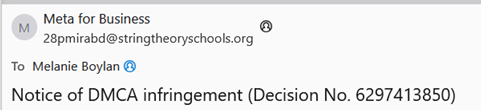
When you’re on your laptop or iPad, you can see a lot more detail:
As you can see, the given name was very official-looking, as was the entire email, but the email address was an obscure Gmail address.
This email had a link to an apparent Facebook video on my Fan page that was using a song I apparently wasn’t allowed to use. I knew for a fact that I hadn’t used it because I don’t have ANY VIDEOS on my page that I have created myself with MUSIC. The only music I ever use is the one available through Facebook editing.
The Page ID is publicly available, so that didn’t frighten me either. It’s all part and parcel of the transparency available on every public page on Facebook.
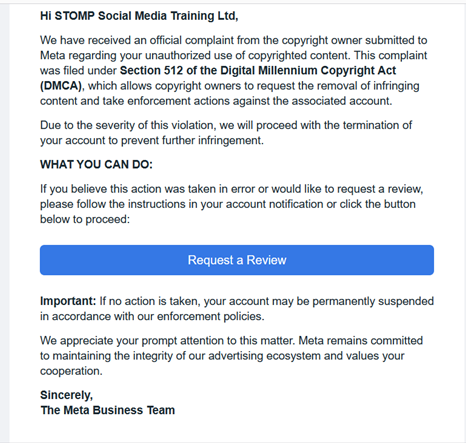
This was taken from their email to me:
Fanpage: “STOMP Social Media Training Ltd”
Page ID: 259696117507828
Infringed Content: Song “Someone You Loved”- 45 seconds used from 0:15 mark
Licensing Status: No authorization or valid license obtained
I continued to do my “homework” and established that the person “Joseph C. Shenker” does indeed exist. He’s currently the Senior Chair of Sullivan & Cromwell LLP, and is a renowned corporate lawyer known for his expertise in complex, high-stakes transactions. Not this kind of thing at all!
I also clarified that Cravath, Swaine & Moore LLP also exists and they also do Copyright Infringement – but the email address mentioned above is NOT accurate.
This was also my FINAL LEGAL NOTICE. If, for some reason, this arrived in my email and not in my spam, surely I would have seen the “previous” emails??
I was told I would expect a follow-up after 72 hours and there was none, so I saved this as an example of a rather terrifying but poor fraud.
Then I received this different email a couple of months before the above:
As you can see, the email was not from Meta
Naturally, I didn’t click the link! The wording, I assume, is verbatim to what Meta would send, and the “unsubscribe” button and the location address of Meta, etc., were all at the bottom of the email as you would expect, all correct as well. However, again, you can see the email is NOT Meta.
In some ways, it’s easier to identify Meta issues.
You can completely ignore any emails and direct messages that you receive, because you need only go into your Meta Business Suite to see if you have received any actual direct notifications from them.
This is a good practice and something you should always do first before clicking on any links you see in DM’s and emails.
“We’re Meta, You Must Listen (We’re Not Really)”You may receive emails from the likes of security@mail.instagram.com, @mail.instagram.com or @support.instagram.com – which are all official Instagram email addresses, but you should still be very cautious because scammers can fake (spoof) emails from this address.
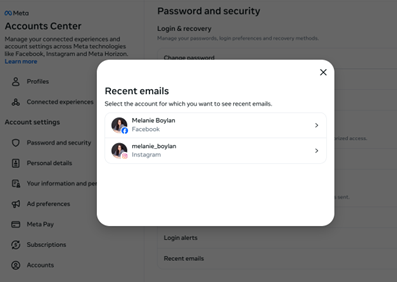
To verify if an email is legitimate, check your account’s “Recent Emails” section in the app settings to see if the email is listed there. Never click any links in suspicious security emails; instead, log in directly to your account through the app to check for any alerts and take action.
To find recent emails sent by Instagram, go to your profile, tap the menu (three lines), you can do this on your laptop or phone, open Accounts Centre, select Password and security, and tap Recent emails. This section displays official emails from Instagram regarding security or logins from the last 14 days.
What to do if you receive a suspicious email:
First, do not click any links!
Legitimate security alerts will not require you to click a link in an email to secure your account.
It’s advisable that you then report the email as spam and block the sender’s address to prevent any future messages.
If you’re still concerned about your account’s security, then change your password and enable two-factor authentication immediately. I appreciate that using 2FA is fiddly, but at least you make it harder for them to steal your hard-earned audience by using it.
I would also make sure to not use your obvious business email to log into your accounts; this can be changed in Meta, again both on your phone and on a laptop/desktop.
On your phone: Navigate to Menu > Settings & Privacy > Settings > Accounts Centre> Personal details > Contact info, where you can add a new email, verify it, and then remove the old one.
On your laptop: To change your Meta account email, navigate to the Accounts Centre on the website or mobile app, go to “Personal details,” select “Contact info,” and add your new email address. You must verify the new email via a confirmation code before removing the old one.
If You Have Been Hacked Already…Don’t despair completely yet! If it’s happened in the last 180 days, or six months, there may be a way of getting it back.
You’ll need to raise a ticket with Meta first and foremost. This is easily the hardest part to do, though! Depending on the type of account you had, the access you had previously and other more fiddly details, there are several routes. You may be able to through your Ads Account, you may have to ask a friend to report it for you, or you may have lost access to your Facebook account but still have access to your Instagram account or vice versa.
Over the years, I have managed to regain access to 3 accounts altogether – that’s it. It’s really hard to do, and frankly, it’s also very time-dependent. You can read about one of my fastest regains in this blog post. It took us 33 days but it nearly stressed the page owner and me out completely.
There is no magic answer or one thing that fits all, unfortunately, but if I can help in any way – please contact me.
Studying Folklore and Mythology: Unlocking the Stories That Shape Cultures
Folklore and mythology are the threads that weave together human imagination, cultural identity, and historical memory. From ancient oral traditions to written epics, myths and folktales have shaped societies, explained natural phenomena, and conveyed moral lessons across generations. Studying these subjects provides a unique lens through which we can understand not only the beliefs and practices of past cultures but also the ways in which storytelling continues to influence contemporary life.
At its core, folklore encompasses the traditional beliefs, customs, and stories of a community, passed down orally or through practice. Myths, often overlapping with folklore, are narratives that explain the origins of the world, human behavior, or societal norms, usually involving gods, heroes, and supernatural events. Together, these disciplines allow scholars to explore the imaginative and symbolic dimensions of human experience. For example, the study of Greek mythology reveals how the Greeks understood concepts of fate, justice, and heroism, while Irish folklore offers insights into local customs, festivals, and the interplay between humans and the natural world.
One of the primary benefits of studying folklore and mythology is developing cultural literacy. By examining myths and folk narratives from different societies, students gain insight into the values, fears, and aspirations of those communities. This understanding fosters empathy and a broader awareness of the diversity of human experience. Furthermore, many modern cultural products, from literature and theatre to film and video games, are deeply rooted in mythological and folkloric traditions. Understanding these narratives allows students to trace the influence of ancient stories on contemporary culture, enhancing critical thinking and analytical skills.
In addition, studying folklore and mythology has practical applications beyond academia. In fields such as literature, creative writing, anthropology, history, and cultural heritage, knowledge of mythic and folkloric structures informs research, storytelling, and preservation efforts. Professionals working in museums, cultural institutions, or tourism industries can draw on this knowledge to create engaging exhibits, educational programs, and culturally sensitive interpretations. Even psychology and sociology benefit from mythological studies, as recurring archetypes and narrative patterns can illuminate human behavior and collective social phenomena.
A particularly compelling aspect of this field is its interdisciplinary nature. Folklore and mythology intersect with history, linguistics, archaeology, religious studies, and art, making it an intellectually rich area for exploration. Analyzing myths and folktales requires not only literary and critical skills but also an understanding of historical context, symbolism, and ritual practices. For instance, studying Norse mythology involves reading ancient sagas, examining archaeological artifacts, and exploring how Viking cosmology influenced Scandinavian societies.
Moreover, folklore and mythology encourage creativity and imagination. By engaging with stories that blend the real and the fantastical, students are inspired to think metaphorically, interpret symbols, and consider multiple perspectives. This imaginative engagement is not only intellectually stimulating but also personally enriching, connecting learners to the universal human impulse to tell stories and make sense of the world through narrative.
Studying folklore and mythology is a window into the human imagination, cultural identity, and societal values. It equips students with critical, analytical, and creative skills while fostering cultural awareness and empathy. Whether one pursues a career in academia, the arts, or heritage sectors, or simply seeks a deeper understanding of human storytelling, the study of folklore and mythology provides timeless insights and enduring fascination. In a world increasingly shaped by global narratives and media, these ancient stories continue to resonate, reminding us that storytelling is both a reflection of who we are and a guide to who we might become.
The purpose of this award is to enable the learner to build the knowledge, skill and competence required for participation in higher education, including acquiring a broad range of knowledge in an area of personal interest, and key skills for academic research and enquiry.
The Folklore and Mythology course at Dublin College Dundrum is listed in Courses.ie’s national courses finder.
The Value of a Professional Certificate in User Research
User research has become one of the most influential disciplines in modern digital product development. From apps and websites to online services and emerging technologies, organisations increasingly rely on evidence-based insights to understand what people truly need and not just what teams assume they want.
A Professional Certificate in User Research equips you with the skills to uncover those insights systematically, ethically, and strategically. For anyone looking to enter or advance within UX, product, design, or digital innovation roles, it offers a powerful combination of practical capability and professional credibility.
Here’s why this qualification is becoming such a valuable career investment.
User Research Is Now Central to Business Strategy
Organisations no longer treat user experience as an optional extra. It is a competitive advantage. Companies that understand their users deeply build better products, reduce costly redesigns, and create stronger customer loyalty.
User researchers help organisations:
Identify real user needs and behaviours
Test ideas before expensive development begins
Improve usability and accessibility
Reduce risk in product decisions
Inform strategy with real evidence
As a result, demand for trained researchers continues to grow across sectors including technology, finance, healthcare, retail, education, and public services.
You Learn a Structured, Professional Research Process
A professional certificate trains you in a repeatable, industry-standard methodology. This is essential because credible research requires careful planning and execution.
Typical core skills include:
Research Planning
Learn how to define research objectives, select appropriate methods, recruit participants, and design ethical, effective studies.
Research Methods
Develop hands-on experience with qualitative and quantitative approaches such as interviews, usability testing, surveys, field studies, and behavioural analysis.
Insight Analysis
Transform raw observations into meaningful findings using frameworks like affinity mapping, thematic analysis, and pattern identification.
Communicating Findings
Present insights clearly to stakeholders through reports, presentations, and visual storytelling that influence real decisions.
These are highly transferable professional skills that apply across industries and roles.
A Globally Recognised Qualification Builds Credibility
In a competitive digital job market, formal recognition matters. A professional certificate signals that you can apply structured research methods, not just informal feedback gathering.
For employers, it demonstrates:
Practical competence
Research literacy
Ethical awareness
Analytical thinking
Communication skills
For professionals transitioning into UX or product roles, certification provides a recognised pathway into the field.
It Supports Career Entry and Career Progression
User research training is valuable at multiple career stages.
Career Changers
People moving from psychology, marketing, education, customer experience, or design often use certification to enter UX research roles.
Early-Career Professionals
Graduates can strengthen employability by adding applied research capability to their skill set.
Experienced Practitioners
Designers, product managers, and developers can deepen their impact by integrating research into decision-making.
User research skills are also foundational for roles such as:
UX Researcher
UX Designer
Product Manager
Service Designer
Customer Experience Specialist
Digital Strategist
You Gain Confidence Through Practical Application
One of the greatest benefits of structured training is confidence. Many professionals gather feedback informally but lack a clear framework for doing it rigorously.
That confidence allows you to contribute meaningfully to product decisions and organisational strategy.
The Industry Is Only Getting Bigger
As digital services expand and user expectations rise, organisations need professionals who can understand behaviour, evaluate experiences, and guide improvement.
Emerging technologies – including AI, immersive interfaces, and complex digital ecosystems – make human-centred research more important than ever.
This is not a niche skill. It is a long-term professional capability with growing relevance.
Is a Professional Certificate in User Research Worth It?
If you want to build a career in UX, product development, or digital innovation, the answer is increasingly yes.
A Professional Certificate in User Research helps you:
✔ Develop practical, in-demand skills ✔ Earn recognised professional credentials ✔ Strengthen career opportunities ✔ Influence real-world decisions ✔ Thrive in a growing global industry
For anyone serious about understanding users and shaping better products because of that understanding, it’s an investment that delivers both professional growth and lasting career value.
The Professional Certificate in User Research is the industry’s most comprehensive course dedicated to user research in UX design. You’ll gain the skills, methods and confidence to uncover user insights that shape outstanding digital experiences, all while earning a globally recognised, university credit-rated qualification.
Delivered online and self-paced, the course offers the flexibility to study around your schedule, with monthly deadlines and structured submissions to help you stay on track. You’ll also have access to 1:1 mentoring, career advice and community support throughout your learning journey.
Turning Curiosity into a Career – Samantha’s Journey into UX Research
In this guest blog for Courses.ie, Cynthia Vinney, writer for the UX Design Institute Blog, shares Samantha’s story of pivoting into UX research.
Samantha, with a background in psychology and people-focused roles, faced the common career switcher challenge of gaining relevant experience. By completing the Professional Certificate in User Research, she gained practical skills, built confidence, and landed her first role as a User Researcher, proving that a structured, hands-on course can turn curiosity and existing strengths into a successful new career.
Samantha wanted to break into user research but, like many career switchers, found it difficult to get hired without hands-on experience. She knew she had the curiosity and problem-solving mindset for the role, but needed a clear pathway into the field. That’s when she turned to the UX Design Institute to kick-start her new career. Here’s how she did it.
Starting out: Samantha’s background in psychology and people-focused roles
Samantha came from people-centred roles, including working as an assistant and office manager. At the time, these roles may not have seemed relevant to UX. In reality, they involved psychology, behavioural science and strong communication skills. They helped her understand people’s needs and listen closely to their motivations, skills that are essential in user research.
Trying to get into UX research and hitting the “lack of experience” barrier
Despite the many strengths Samantha had, she found making the switch to UX research wasn’t easy. In fact, she faced a familiar catch-22 that many aspiring UX researchers encounter.
After completing my MSc in Psychology, I wasn’t sure how to make the leap into UX research, as the industry seemed highly competitive. I felt stuck in the cycle of needing UX experience to get a job, and needing a job to gain that experience.
Forging a practical pathway into UX with the Professional Certificate in User Research
Then Samantha found the UX Design Institute and the Professional Certificate in User Research, which she calls “instrumental” in starting her career in user research. The practical course bridged the gap, getting her the experience she needed to get a job. She completed hands-on learning to gain applicable skills in UX research that employers saw as relevant and useful to the industry.
The course broke everything down into clear, manageable pieces, so I never felt overwhelmed. I gained insights into how psychological principles can be applied within the business sector.
I appreciated the fact that the technological aspect was also included, for example, how to set up an interview. I believe these small but crucial details helped secure my new role as a UX Researcher.
Samantha valued the high-quality education she received. She found the course current and closely aligned with industry needs. Most importantly, it helped her turn a long-standing curiosity about people and behaviour into practical UX research skills. She learned how interests she had always been drawn to could be applied as clear, actionable research insights.
From theory to practice: gaining confidence as a UX researcher and landing her first role
Her confidence grew as she learned how to plan, run and analyse research through the Professional Certificate in User Research. She then applied those skills to real-world projects. With that experience, she was ready to step into her first full-time UX research role.
Today she works as a User researcher for AMS leading qualitative and quantitative studies, developing personas and facilitating rapid prototyping.
I have my dream job in UX research, thanks to the UX Design Institute.
Samantha’s story shows that many professional backgrounds can lead to a career in UX research. In her case, psychology and strong people skills were a natural fit, but they were not a requirement. With the comprehensive and supportive structure of the course, UX research is accessible to anyone willing to focus on empathy, problem-solving and understanding users.
Think a UX career is out of reach? A professional course can change that.
Like Samantha, you can break into UX research without prior experience and move towards your dream role. The Professional Certificate in User Research is designed to help you build job-ready skills through a structured, supportive learning path. You’ll gain practical experience, learn in-demand research methods and stay aligned with current industry trends.
With the Professional Certificate in User Research you’ll:
Build a well-rounded UX research skillset by learning a complete range of in-demand research methods
Develop the ability to turn research findings into clear, actionable insights and communicate them with confidence
Apply your learning to practical projects and showcase your expertise in a professional UX research portfolio
Gain a university credit-rated qualification that supports your long-term career growth
Learn within a supportive environment, with guidance from career advisors, our Student Success team and an engaged student community
How Long Does it Take to Become a Certified Nutrition Coach?
If you’ve ever considered becoming a nutrition coach, you’ve probably asked yourself one big question: how long will it take before I can start working with clients? In this guest post, Paddy Farrell, Trainer, Nutritionist, Coach, and Co-Founder & Head of Education at Triage Method, breaks down the timeline for nutrition coaching certifications, explains the factors that affect how long it takes, and compares becoming a certified nutrition coach to pursuing a registered dietitian qualification.
Whether you’re looking to make a fast career change or prefer a slower, self-paced approach, Paddy’s insights will help you understand the path, the commitment required, and how soon you can start coaching clients. This is an essential read for anyone exploring a career in nutrition and wellness.
If you’re considering becoming a nutrition coach, you’re probably wondering how much time you’ll need to invest before you can start working with clients. It is surprisingly hard to get clear answers to how long does it take to become a certified nutrition coach. And the reason is because the answer depends on which path you choose, and there’s also a massive difference between becoming a nutrition coach versus becoming a registered dietitian.
The reality is that you can become a certified nutrition coach and start coaching clients in as little as 4 weeks, or take up to 6 months if you prefer a slower pace. Compare that to becoming a registered dietitian, which requires 5-8 years of education, including a master’s degree, 1,200+ hours of supervised practice, and passing a national exam.
This article will walk you through the timeline for nutrition coaching certifications, what affects how long it takes, and help you decide which path makes sense for your goals.
The Quick Answer: 4 Weeks to 6 Months
Most nutrition coaching certifications can be completed in 4 weeks to 6 months, depending on:
Which nutrition coaching certification you choose
How much time you can dedicate per week
Whether you’re studying full-time or part-time
Your existing knowledge of nutrition
Some programs are entirely self-paced, meaning you control the timeline. Someone studying 15-20 hours per week could finish in a month, while someone with a full-time job studying 5-8 hours weekly might take 3-4 months.
What Affects Your Timeline?
Several factors determine how quickly you’ll complete your certification:
Your available study time. This is the biggest variable. Someone studying 2-3 hours per week will naturally take longer than someone dedicating 10-15 hours weekly. Most certifications are designed assuming 5-10 hours of weekly study, which works for people with full-time jobs or other significant commitments.
Your existing nutrition knowledge. If you’re coming from a background in health, fitness, or science, you’ll likely move through the material faster than someone entirely new to nutrition. Topics like macronutrients, metabolism, and energy balance will be familiar territory rather than completely new concepts. That said, even beginners can complete these certifications, as they’re designed to be accessible to people with no prior nutrition education.
The certification’s structure. Some programs have more content and more rigorous exams than others. Triage Method’s 75 hours of coursework naturally takes longer than a lot of other programs.
How you learn best. Some people retain information better by reading once through carefully. Others need to review material multiple times. Some prefer to study one module completely before moving on, while others like to get an overview of everything first. Self-paced programs allow you to adapt to your learning style, which can actually speed up your completion time compared to rigid cohort-based programs.
Nutrition Coach vs Registered Dietitian: The Time Difference
It’s worth understanding the massive difference in time commitment between these two paths, because many people confuse them.
Nutrition Coach Certification: 4 weeks to 6 months of self-paced study. Total investment: roughly €400-€1,400 and 25-75 hours of study time. You can start coaching clients immediately upon certification.
Registered Dietitian (RD/RDN): 5-8 years minimum. This includes 4 years for a bachelor’s degree, 2-3 years for a required master’s degree (as of 2026, a master’s is mandatory to sit for the exam), 6-12 months for a 1,200-hour supervised dietetic internship, plus time to prepare for and pass the Commission on Dietetic Registration exam. Total investment: €20,000 – €100,000+ in tuition alone, plus living expenses during full-time internships.
The paths have different scopes of practice. Registered dietitians can work in clinical settings, provide medical nutrition therapy, diagnose nutrition-related conditions, and often qualify for insurance reimbursement. Nutrition coaches help clients with general nutrition guidance, habit formation, and lifestyle changes, but cannot diagnose conditions or prescribe meal plans for medical conditions.
For most people wanting to help clients with nutrition, a coaching certification is the appropriate credential. It’s only if you want to work in hospitals, provide medical nutrition therapy, or have the most expansive clinical scope that you’d need to pursue the RD path.
How Long Does the Triage Method Nutrition Certificate Take?
The Triage Method Nutrition Coaching Certification is entirely self-paced, and you could complete it in as little as 2 weeks with intensive study, or take up to 2 years if you prefer a slower pace. Most students complete it within 2-4 months when studying part-time.
The course includes 75 CPD hours of content across six comprehensive modules:
Digestion, Assimilation and Metabolism
Calories and Macronutrients
Food Selection
Tiered Nutrition Coaching (The Triage Tier System)
Client Intake and Assessment
Coaching Nutrition
The final exam is 60 minutes with 100 multiple-choice questions. You need 70% to pass and get three attempts (with additional options available if needed). Throughout the course, you’ll take multiple practice exams to gauge your readiness, so you shouldn’t be surprised by the final exam if you’ve understood the material.
What makes this program different is the focus on both theory and practice. You’re not just learning nutritional science; you’re learning how to actually coach someone to better nutrition in the real world. The Tiered Nutrition Coaching system gives you multiple implementation methods for different client needs and preferences, because there’s no one-size-fits-all approach.
Can You Complete a Certification While Working Full-Time?
Absolutely. All the major nutrition coaching certifications are designed specifically for working professionals. Here’s what that looks like in practice:
Studying 5-8 hours per week (roughly an hour per day), you can complete most certifications in 2-4 months. This is the pace most people follow, often studying in the evenings after work or on weekends.
Studying 10-15 hours per week (if you have more flexible time or want to finish faster), you can complete most programs in 4-8 weeks. This might mean dedicating a few hours each evening plus longer sessions on weekends.
Studying 20+ hours per week (if you’re between jobs, have taken time off, or can dedicate significant time), you can complete certifications in 2-4 weeks at the fastest end.
The self-paced format means you’re never locked into a schedule that doesn’t work for you. There are no live classes to attend, no cohorts you need to keep pace with, and no deadlines (except for exam attempts, which typically give you several months to a year). You can study at 6am before work, during lunch breaks, at 11 pm, or whatever works for your life.
What Happens After You’re Certified?
Once you pass your exam, you can start coaching clients immediately. There’s no additional supervised practice requirement, no internship, no waiting period.
Most certifications either never expire (like Triage Method’s) or require renewal every 2 years with continuing education credits. For example, NASM requires renewal every 2 years through completion of a renewal exam. Precision Nutrition requires you to retake a short exam every 2 years to maintain your certification.
The timeline from “I want to become a nutrition coach” to “I’m certified and coaching clients” can genuinely be as short as 4-6 weeks if you choose a faster program and dedicate sufficient study time. Compare that to nearly any other career change, and it’s remarkably quick.
Choosing Your Timeline
Here’s how to think about which timeline is right for you:
Choose a 4-8 week timeline if you want to start coaching as quickly as possible, can dedicate 10-20 hours per week to studying, and prefer intensive, focused periods of learning.
Choose a 3-6 month timeline if you’re working full-time and want to study at a sustainable pace without overwhelming yourself, can dedicate 5-10 hours per week, and want time to really absorb and apply the material as you learn.
Choose a 6-12 month timeline if you want maximum flexibility, have unpredictable schedules, want to implement what you’re learning with clients as you go, or simply prefer not to rush. Any of these programs can be stretched over a longer timeframe; they’re all self-paced with lifetime or extended access.
The question isn’t just “how fast can I complete this?” but “what pace allows me to actually learn and retain this information?” Rushing through material to finish faster doesn’t help if you don’t remember it when you’re actually coaching clients.
How Long Does It Take to Become a Certified Nutrition Coach: The Bottom Line
Becoming a certified nutrition coach takes 4 weeks to 6 months, depending on which program you choose and how much time you can dedicate per week. This is dramatically faster than the 5-8 years required to become a registered dietitian, and for most people wanting to help clients with nutrition, a coaching certification is exactly what you need.
The self-paced nature of these programs means you control the timeline. You can complete a certification in a month with focused effort, or spread it over half a year while working full-time. There are no right or wrong timelines, only what works for your situation.
What matters most is choosing a certification that teaches you not just nutritional science, but how to actually coach clients to change their nutrition in the real world. That’s the difference between understanding nutrition academically and being able to help someone implement better nutrition in their actual life.
Ready to become a nutrition coach?
Our Nutrition Coaching Certification is entirely self-paced, meaning you can complete it in as little as 2 weeks or take up to 2 years; whatever works for your schedule. You’ll get immediate access to all content (no drip-feeding), learn both nutritional science and how to actually coach clients, and earn 75 CPD hours upon completion.
Sports massage therapy is increasingly recognised as an essential part of health, wellness, and athletic performance. Practitioners combine deep tissue massage techniques with an understanding of common soft tissue issues, including muscle tension, aches and pains, sports injuries, and rehabilitation. This blend of hands-on skill and anatomical knowledge makes sports massage therapists valuable to both athletes and the general public.
The demand for qualified, professional therapists continues to grow, offering opportunities for flexible careers, whether working full-time with sports teams or part-time providing treatments to clients seeking recovery, injury prevention, or relaxation.
A successful sports massage therapist needs a strong foundation in several key areas:
Anatomy and Physiology – Understanding the human body, how muscles and joints interact, and how physical activity impacts the body is crucial.
Massage Techniques – Mastery of targeted massage methods helps alleviate pain, prevent injury, and support recovery.
Client Consultation and Assessment – Effective therapists assess clients’ needs carefully, plan treatments, and adjust techniques for the best outcomes.
Many practitioners find that this field not only offers a rewarding career helping people improve mobility, manage injuries, and enhance performance, but also provides flexibility and work-life balance. Whether supporting professional athletes, weekend sports enthusiasts, or the wider public, sports massage therapy combines technical expertise with meaningful, client-focused work.
With growing awareness of wellness, rehabilitation, and recovery, a career in sports massage provides a stable and fulfilling pathway for anyone interested in health, fitness, and hands-on therapeutic practice.
How a QQI Level 6 Qualification Builds Professional Credibility in Modern Industry
As Irish industry becomes more regulated and data-driven, experience alone is no longer enough. Employers and regulators increasingly look for nationally recognised qualifications to sit alongside hands-on expertise.
In this guest blog, ESS Ltd. explores how QQI Level 6 qualifications formally recognise professional competence and support safe, compliant, and future-ready industrial careers.
Skill, accuracy, and safety have always defined good industrial practice. Whether you are maintaining electrical systems, managing assets, or calibrating instrumentation in a regulated environment, Irish industry depends on professionals who understand their work and apply it consistently.
What has changed is not the value of experience, but how that experience is recognised. As industrial operations become more connected, more data-led, and more closely regulated, employers and regulators are placing greater weight on formal, nationally recognised qualifications that sit alongside hands-on expertise.
This is where a QQI Level 6 qualification plays a practical role. It provides structured recognition of professional competence and translates real-world experience into a standard that is understood across industry.
What QQI Level 6 Qualification Represents
Quality and Qualifications Ireland (QQI) provides the national framework used to measure learning and competence in Ireland. A Level 6 award sits at an advanced technical level and reflects applied knowledge, sound judgement and a clear understanding of safety, quality and compliance in the workplace.
For many technicians, engineers and maintenance professionals already in employment, a QQI Level 6 qualification is a way to formally recognise knowledge developed through years of practical experience. It presents that experience in a structured format that is recognised by employers, auditors, and regulatory bodies.
At the same time, Level 6 qualifications are not limited to those already established in industry. They are also used by people seeking to formalise existing skills gained in less structured settings, by those planning a career change into technical or industrial roles, and by individuals looking for a recognised entry point into the sector.
In practical terms, a QQI Level 6 qualification signals that capability has been assessed, validated, and aligned with national standards, regardless of whether that learning was built on site, through training, or as part of a career transition.
Why Formal Certification Matters in Today’s Industrial Roles
Industrial environments are evolving quickly. Asset management systems are more integrated, data is playing a bigger role in maintenance decisions, and compliance expectations continue to rise across sectors such as manufacturing, pharmaceuticals, utilities, and energy.
Within this context, structured certification supports professionals in several clear ways:
It builds professional credibility by demonstrating alignment with nationally recognised safety and technical standards.
It supports adaptability as systems, tools, and regulations change.
It connects practical experience with formal recognition, helping experienced personnel evidence what they already do well.
Rather than replacing experience, certification reinforces it and gives it a shared, portable meaning.
Where QQI Level 6 Certification Adds Practical Value
Across industry, professionals use QQI Level 6 qualifications to strengthen specific areas of responsibility rather than narrow job titles. Based on what we see through our training programmes, several technical and operational areas consistently stand out.
Industrial Electrical Safety and Systems
Electrical systems underpin almost every industrial process. Certification in Industrial Electrical Safety and Systems supports a stronger understanding of system behaviour, fault diagnosis, and safe working practices. These skills directly contribute to plant reliability, reduced risk, and compliance with safety standards.
Industrial Instrumentation Calibration
In regulated environments, accuracy and traceability are essential. Formal learning in Industrial Instrumentation Calibration supports correct instrument selection, documentation, and audit readiness, while building confidence in the data used to make quality and production decisions.
Manufacturing, Maintenance, and Reliability Roles
As maintenance continues to move towards predictive and condition-based approaches, professionals are expected to work across mechanical, electrical, and analytical boundaries. QQI Level 6 learning in Industrial Manufacturing and Maintenance Skills strengthens the technical foundation needed to support reliability, availability, and continuous improvement.
Asset Management and Digital Systems
Modern maintenance relies increasingly on structured asset management systems and digital tools. Certification in Asset Management Digitalisation supports understanding of how assets are configured, monitored, and managed across their lifecycle, linking technical activity with planning, reporting, and performance outcomes.
Data, AI, and Machine Learning in Maintenance
As data volumes grow, maintenance and reliability teams are engaging more with analytical tools and decision-support systems. Structured learning in Utilising Artificial Intelligence and Machine Learning for Asset Management helps professionals understand how data-driven methods are applied in real industrial settings rather than as abstract concepts.
Certification as a Shared Professional Standard
Experience will always sit at the core of technical roles, but certification provides a common reference point. When a QQI Level 6 qualification appears on a CV or training record, it communicates capability in a way that is clear to employers, regulators, and auditors.
It also supports movement across roles, sites, and sectors, because the qualification carries recognised meaning beyond any single workplace.
Continuous Learning in a Structured Way
Learning has always happened on the job, through problem-solving, mentoring, and exposure to real systems. What has changed is the ability to make that learning visible and measurable.
Short courses and targeted training help professionals stay current in specific areas. A QQI Level 6 qualification provides structure and coherence to that learning, showing sustained development rather than isolated updates.
Many professionals now combine both approaches, using focused training for immediate needs and Level 6 qualifications to anchor their expertise within the national framework.
Supporting Industry Through Recognised Standards
ESS has long worked alongside industry to develop training that reflects real operational demands. Our QQI-accredited programmes are shaped by practitioner input and grounded in how work is actually carried out, not abstract theory.
The aim is simple: to help professionals convert experience into recognised achievement while supporting the standards that keep Irish industry safe, compliant, and competitive.
Considering Your Next Step
For many technicians, engineers, and managers, a QQI Level 6 qualification is not a career change. It is confirmation of professional capability and a practical way to support future progression.
To explore current programmes and see which option aligns with your role or responsibilities, view our training and certification options.
ESS Ltd. is a specialist provider of Asset Management, Maintenance and Reliability Excellence and Technical Training that support organisations through education and training. ESS courses afford companies and learners alike the opportunity to upskill, develop their people, maintain compliance, drive efficiency, sustainability, and continuous improvement.
Training is a culmination and a merging of proven academia philosophies and principles with practical, hands-on experience from the ESS team of SME’s. ESS strongly believe the partnership of academia and seasoned practitioners, is a unique value-added service. This service is on offer to all clients and results in improvements that are immediate, valuable, and sustainable.
Exploring Amatsu Therapy: Restoring Balance Through Gentle Bodywork
Amatsu Therapy is an increasingly popular form of bodywork that combines gentle movement, pressure, and realignment techniques to support physical and emotional balance.
Originating in Japan, Amatsu is grounded in the principle that many musculoskeletal and postural issues arise from imbalances in the body’s structure and subtle energy systems. Through carefully guided movements, therapists work to release tension, improve joint mobility, and enhance the body’s natural self-healing capabilities. Unlike deep tissue massage, Amatsu is gentle yet highly effective, focusing on the root causes of discomfort rather than simply alleviating symptoms.
Benefits of Amatsu Therapy include:
Improved posture and alignment
Relief from chronic pain or muscular tension
Enhanced flexibility and range of motion
Support for emotional well-being through stress reduction
Better circulation and energy flow
Amatsu therapists assess the whole body, observing how movement in one area affects other regions, and use a series of precise, gentle manipulations to correct imbalances. Clients often report feeling lighter, more mobile, and more relaxed after a session, with longer-term improvements in posture and overall vitality.
Who Can Benefit? Amatsu Therapy is suitable for people of all ages, including those recovering from injuries, athletes seeking to optimise performance, or anyone experiencing chronic tension or stress. Its gentle approach makes it accessible even to individuals who may not tolerate more intensive therapies.
Training and Certification For those interested in pursuing a career in Amatsu Therapy, many accredited courses are available, ranging from introductory workshops to advanced certification programs. Training covers anatomy, postural assessment, hands-on techniques, and client care, providing the practical skills needed to deliver safe and effective therapy.
Amatsu Therapy offers a unique and gentle approach to achieving physical balance, emotional calm, and overall wellness. Whether you’re seeking personal benefits or a professional pathway, learning about Amatsu can be a transformative experience.
Helping people improve their relationship with food often starts with a simple realisation: you want to turn your interest in nutrition into meaningful work. In this guest blog for Nightcourses.com, Nutritionist & CBT Therapist Brian Ó hÁonghusa shares a clear, practical guide to becoming a nutrition coach. Drawing on real-world experience, Brian cuts through the confusion around qualifications, timelines, and career pathways, outlining what’s actually required to start coaching clients safely, confidently, and professionally.
You want to help people eat better and improve their health. Maybe you’ve already transformed your own relationship with food and want to help others do the same. Or you’re a personal trainer tired of watching clients struggle with nutrition despite training consistently. You have realised that you want to become a nutrition coach.
Luckily for you, becoming a nutrition coach is significantly faster and more affordable than you might think. You don’t need a four-year degree. You don’t need to go back to university. Most people can become certified nutrition coaches in 2-6 months for about €1000.
But (and this is important to understand) the pathway isn’t identical for everyone. What you need depends on where you live, what kind of coaching you want to do, and whether you’re adding nutrition to existing credentials or starting from scratch.
This guide walks you through the actual steps of how to become a nutrition coach. This is not theoretical possibilities, but rather, it is the practical pathway from “I want to do this” to “I’m coaching clients, delivering a great service and earning good money.”
What Does a Nutrition Coach Actually Do?
Before we talk about becoming one, let’s clarify what nutrition coaches actually do, because there’s often confusion between nutrition coaches, nutritionists, and registered dietitians.
As a nutrition coach, you:
Educate clients about nutrition fundamentals (macros, food quality, portion sizes)
Help clients build sustainable eating habits
Provide general nutrition guidance for healthy populations
Create sample meal plans and food ideas
Coach behaviour change around food choices
Help clients navigate confusion from conflicting nutrition information
Provide accountability and support
What you cannot do (without additional credentials):
Provide medical nutrition therapy
Diagnose nutrition-related diseases
Create therapeutic diets for medical conditions
Work in clinical settings treating patients
Bill insurance for nutrition services
Call yourself a “registered dietitian” (that’s a protected title requiring specific education)
The distinction matters legally and practically. As a nutrition coach, you’re working with generally healthy people who want to lose weight, build muscle, increase energy, or simply eat healthier. You’re not treating medical conditions.
For 90% of people who want help with nutrition (i.e. the busy professional who eats too much takeaway, the parent trying to feed their family healthily, the athlete wanting to optimise performance), a nutrition coach is exactly what they need.
Step 1: Understand Your State or Country’s Requirements
Here’s where it gets slightly complicated: nutrition coaching regulations vary significantly by location.
In most countries: You don’t need a license to provide general nutrition coaching services. You can educate people about nutrition, provide meal ideas, and coach behaviour change without formal licensing, as long as you’re not providing medical nutrition therapy or claiming to be a dietitian.
Some locations have stricter rules: Certain US states (like Florida) require licensing for anyone providing nutrition counselling, while others (like Montana) allow general nutritional information without licensing as long as you don’t represent yourself as a dietitian or nutritionist.
Check the National Association of Nutrition Professionals’ interactive map (for US states)
Contact your local regulatory board directly if unclear
The practical reality: Most places allow you to provide nutrition coaching services under titles like “nutrition coach,” “wellness coach,” or “health coach” without specific licensing. The restrictions typically kick in when you:
Provide medical nutrition therapy for disease conditions
Use protected titles like “dietitian” or “nutritionist” (in some states)
Work in clinical or medical settings
If you’re planning to work in gyms, studios, corporate wellness, or building your own coaching business with healthy populations, you’re likely fine in most locations. But always verify your specific situation.
Step 2: Choose Your Certification Path
While you may not legally need certification in many places, getting certified is strongly recommended for three reasons:
Education: You’ll actually learn nutrition science and coaching skills rather than winging it
Credibility: Clients and employers want to see credentials
Marketability: Many gyms, studios, and wellness programs require certification
The Triage Method Nutrition Coaching Certification for example costs €1,000 (approximately $1,050), created by practitioners with 10+ years of real-world coaching experience, 75 CPD hours, teaches a tiered coaching system for different client types. Best if you want practitioner-focused training that teaches multiple coaching approaches, not just one methodology. Best value for money, considering the depth of content you get access to.
Time investment: Most certifications take 2-6 months to complete if you’re studying part-time while working. Full-time focus could reduce this to 4-8 weeks for some programs. Triage Method is self-paced with no time limits, complete in 2 weeks or 2 years, it’s completely your choice.
You don’t need a bachelor’s degree, pre-existing fitness credentials, or science background to become a nutrition coach. If you have these things, great, they’ll help. But they’re not required.
Step 3: Complete Your Certification Program
Once you’ve chosen your certification, here’s what the actual study process looks like:
Typical study timeline:
5-10 hours per week studying → 2-3 months to complete
10-15 hours per week studying → 4-8 weeks to complete
Full-time focus → As fast as 2-4 weeks (though rushing isn’t ideal)
What you’ll actually learn:
Nutrition science fundamentals: Digestion, metabolism, macronutrients, micronutrients, energy balance, supplements, and body composition.
Behaviour change psychology: Why people struggle to eat better despite knowing what to do, how to coach habit formation, overcoming resistance, and maintaining adherence.
Practical coaching skills: Client assessments, goal setting, meal planning, progress tracking, and communication strategies.
Business basics: How to work with clients, scope of practice, and liability considerations.
Study approach that works:
Don’t just memorise, actually try to understand the “why” behind recommendations so you can adapt to real clients
Take notes as you go, especially practical application examples
Use practice exams if provided; they show you what you actually need to know
Study consistently rather than cramming; the information sticks better
Apply as you learn. Practice explaining concepts to friends or family
Most programs include chapter quizzes throughout, with a final exam at the end. Exams typically have 60-100 multiple choice questions with 70-75% pass rate. You usually get 2-3 attempts included.
The exams aren’t designed to trick you; they’re testing whether you understood the material well enough to coach safely and effectively.
Step 4: Pass Your Certification Exam
Most nutrition coach certification exams are:
Taken online from your own computer
Open book (for many programs) or untimed/unproctored
100 questions on average (range: 60-120 questions)
70-75% passing score required
2-3 attempts included in your certification fee
Exam preparation tips:
Review all practice exams and chapter quizzes
Focus on practical application, not just memorising definitions
Understand behaviour change principles, as these are heavily tested
Know your scope of practice (what you can and cannot do)
Don’t overthink questions, as your first instinct is usually correct
If you fail: Don’t panic. Most programs allow multiple attempts. Review your weak areas, study those sections more thoroughly, and retake when ready. Additional attempts typically cost €50-€200 if you exceed the included attempts.
After passing: You’ll receive a digital certificate immediately (usually) and sometimes a physical certificate within 4-6 weeks. You can start coaching right away (don’t wait for the physical certificate!).
Step 5: Start Coaching (While You Continue Learning)
Here’s what many new coaches get wrong: they think they need to know everything before taking their first client. You don’t.
You need to know enough to help people safely and effectively, and your certification provides that. But the real learning happens when you start working with actual humans with actual struggles.
How to get your first clients:
If you’re already a personal trainer: Tell your existing clients you’re now certified to provide nutrition guidance. Many will immediately want to add nutrition coaching to their training. This is the fastest path to nutrition coaching income.
If you’re starting from scratch:
Offer free consultations to 5-10 people to practice your intake process and assessment skills
Start with friends, family, and colleagues who’ve expressed interest in improving their nutrition (this is most people!)
Post on social media about your new certification and offer discounted intro packages
Join online fitness communities and provide valuable free content (not spam)
Partner with local gyms or studios offering nutrition services to their members
Pricing for new coaches: €40-€75 per hour is reasonable when you’re new. As you gain experience and results, increase to €75-€150+ per hour. Many coaches shift to package pricing (€500-€2,000 for 3-6 months) once established.
What to charge:
Don’t undercharge; you have professional credentials and valuable knowledge
Don’t overcharge before you have testimonials and proven results
Regional differences matter (urban areas can charge more)
Online coaching removes geographic limitations
Timeline: How Long Does It Actually Take?
Fastest possible path: 4-6 weeks
Choose self-paced certification
Study full-time (20-30 hours/week)
Pass exam on first attempt
Start coaching immediately
Realistic timeline for most people: 3-6 months
Choose a certification program (1-2 weeks research)
Complete coursework part-time while working (2-4 months)
Pass exam (immediate to 2 weeks if retake needed)
Get first clients (1-4 weeks)
Leisurely pace: 6-12 months
Study casually around your busy schedule
Take time to deeply understand the material
Build confidence before launching
The timeline depends entirely on your schedule and how quickly you want to start. There’s no “right” speed, and faster isn’t necessarily better if you’re rushing through important material.
Salary Expectations: What Can You Actually Earn?
Let’s talk real numbers, because earning potential varies dramatically based on employment type, location, and how you structure your business.
Client type (general population vs. executives or athletes)
The realistic path: Most new coaches start earning €25,000-€40,000 in their first year while building a client base. By year 2-3, with consistent effort and good client results, €60,000-€80,000 is achievable. Top earners who specialise, build strong reputations, and create scalable systems (group programs, online courses) can reach €100,000+.
Here’s what affects your earning potential more than almost anything else: your ability to get and retain clients. Certification gives you knowledge. Business skills and coaching ability determine your income.
Common Misconceptions About Becoming a Nutrition Coach
“I need a degree in nutrition” Not true for coaching. You need a degree to become a registered dietitian (RD), which is a different credential requiring 4-6 years of university education plus supervised practice hours. Nutrition coaches work with healthy populations on general wellness, not medical nutrition therapy.
“Certification guarantees clients” Certification proves you have knowledge; it doesn’t automatically bring clients. You still need to market yourself, build credibility, and deliver results that people talk about.
“I can prescribe specific diets for medical conditions” No. Your scope of practice as a nutrition coach is general wellness for healthy populations. Medical nutrition therapy requires RD credentials. Refer clients with medical conditions to registered dietitians or their doctors.
“I need to be in perfect shape myself” Helpful but not required. Your job is helping others improve, not being a perfect example. That said, clients do notice if you clearly don’t practice what you preach. You don’t need to be stage-ready, but you should demonstrate reasonable health habits.
“All certifications are basically the same” Not true. Quality varies significantly. Programs created by practitioners who’ve actually coached thousands of clients teach differently than purely academic programs. Some jobs require certain accreditation. Some certificates are better if you want to work in a company, or if you want to work for yourself.
Final Thoughts: Just Start
The biggest mistake aspiring nutrition coaches make isn’t choosing the wrong certification or taking too long to study. It’s never actually starting.
They research endlessly. They compare programs for months. They wait until they feel “ready” (you never will). They worry about having perfect answers to every possible question.
Meanwhile, people around them continue struggling with nutrition. They continue eating in ways that make them feel terrible. They continue failing with diets that don’t fit their lives. They continue needing exactly the help you could provide, if you’d just get certified and start.
Choose a reputable certification. Complete the coursework. Pass the exam. Start coaching. Learn and improve as you go.
The world needs more coaches who genuinely care about helping people improve their relationship with food and their health. If that’s you, stop researching and start the process.
Ready to learn nutrition coaching from practitioners, not just academics?
Our Nutrition Coaching Certification teaches you not just what to recommend, but how to coach different types of clients using the Triage Tier System. Created by coaches with 10+ years real-world experience helping thousands of clients achieve lasting results.
At Triage, we help committed health and fitness professionals become outstanding at what they do.
In a crowded industry full of shortcuts, generic advice, and hype-driven marketing, we focus on what truly matters:
Deep knowledge and real-world coaching skills that guarantee the best client results and satisfaction.
We offer evidence-based, industry-leading certification courses in:
Nutrition Coaching
Sleep Coaching
Stress Management Coaching
Exercise Program Design
Our courses are trusted by personal trainers, nutritionists, online coaches, and health professionals across Ireland and beyond.
They’re designed not just to provide information, but to transform your capabilities – allowing you to work confidently with a wider range of clients, deliver better results, and build a reputation you can be proud of in this industry.
Who We Are?
Triage is a multidisciplinary team with extensive academic expertise and decades of in-the-trenches coaching experience. Between us, we’ve completed multiple degrees in medicine, nutrition, psychotherapy, biochemistry & physiotherapy, delivered university lectures, and coached thousands of clients. We understand both the science and the real-world application and we’ve built our courses to bridge that gap.
What Makes Us Different?
Evidence-based, up-to-date content delivered in a way that is easy to understand and apply.
Flexible online learning that fits around your schedule in video and written format
Built by professionals, for professionals – no fluff, no filler. We know what works and we want to share it with you.
Practical coaching frameworks to help you create real behaviour change
Ongoing support from our expert team
Industry credibility – our students go on to build thriving businesses or deepen their work and enhance their hire-ability within clinics, gyms, and allied healthcare settings.
Whether you’re a seasoned coach looking to sharpen your edge or just starting out and want to stand out for the right reasons, Triage will give you the tools, confidence, and credibility to be the absolute best you can be and a force within the industry.
Costing and Pricing: How to Work Smarter to Maximise Profit
For many business owners, freelancers, or budding entrepreneurs, determining the right price for products or services can feel like navigating a minefield. Price too low, and you risk leaving money on the table; price too high, and you may lose customers. Understanding costing and pricing is essential to work smarter, make informed decisions, and generate the best possible profit.
Understanding Costing
At its core, costing is about understanding exactly how much it costs to produce your product or deliver your service. This includes:
Direct costs: Materials, ingredients, or any resources directly used in production
Indirect costs: Rent, utilities, marketing, insurance, and other overheads
Variable costs vs. fixed costs: Costs that change with production volume versus those that remain the same
By accurately calculating all these costs, you know your baseline — the minimum price at which you can sell without losing money.
Demystifying Pricing
Once you know your costs, pricing is about deciding how much to charge for your product or service. Pricing isn’t just about covering costs — it’s about:
Positioning: How you want your brand to be perceived in the market
Value perception: What your customer believes your product or service is worth
Market conditions: Competitor pricing, industry standards, and customer demand
A strategic pricing approach ensures that your pricing is both competitive and profitable.
Working Smarter, Not Harder
Many business owners focus on working longer hours to increase profit, but smarter approaches often yield better results. Here’s how:
Know Your Numbers – Accurate costing and pricing data allows you to make quick, confident decisions.
Analyse Your Profit Margins – Identify which products or services generate the highest profit per hour or unit and focus on them.
Adjust Prices Strategically – Small price adjustments can significantly increase profit without affecting sales.
Bundling and Upselling – Offering packages or add-ons increases revenue per customer with minimal extra work.
Minimise Waste and Inefficiency – Reducing unnecessary costs directly boosts your bottom line.
Benefits of Smart Costing and Pricing
Better profitability: You’re more likely to cover costs and earn more per sale.
Informed decision-making: Pricing decisions are backed by data, not guesswork.
Competitive advantage: You can position your offerings strategically in the market.
More time for growth: Working smarter frees up time for marketing, networking, or launching new products.
Learning Opportunities
Understanding costing and pricing isn’t just for finance professionals. Whether you’re running a small business, freelancing, or planning to start your own venture, developing these skills can be transformative.
Courses in business management, finance for non-finance professionals, or entrepreneurship can help you demystify costing, pricing, and profit strategies, giving you the confidence to grow your business successfully.
Costing and pricing may seem complex at first, but with the right approach, they become powerful tools to work smarter and maximise profit. By knowing your costs, understanding your market, and strategically setting your prices, you can ensure your business not only survives but thrives.
Working smarter, not harder, is the key to long-term profitability and it starts with mastering the numbers behind your business.
Pitman Training Centre (Carlow – Kilkenny) offer a Costing and Pricing hands on, practical course, dealing with real scenarios and help demystify some of the complexities around costing and pricing, so you get the best possible results.
This course will help you see how to be really focused on working smarter to generate more profit.
Artificial Intelligence is now part of everyday life, shaping how we work, learn, create and communicate. One of the fastest-growing and most talked-about areas of artificial intelligence is Generative AI. But what does that actually mean?
If you have ever used tools that can write text, create images, generate music, design presentations or even write computer code, then you have already encountered Generative AI in action.
This article explains what Generative AI is, how it works, and why it matters for students, professionals and businesses.
What Is Generative AI?
Generative AI is a type of artificial intelligence that can create new content rather than simply analysing or categorising existing data. Unlike traditional AI systems that focus on recognising patterns or making predictions, Generative AI produces original outputs based on what it has learned.
It can generate:
Text such as articles, reports, emails and social media posts Images, illustrations and digital artwork Videos and animations Music and audio Computer code Marketing content and product designs
In simple terms, Generative AI learns from massive amounts of data and then uses that knowledge to create something new that resembles human-made content.
How Does Generative AI Work?
Generative AI systems are trained on very large datasets that include text, images, sounds or videos. These systems use advanced machine learning models called neural networks to identify patterns, relationships and structures within that data.
Once trained, the model can respond to prompts or instructions by generating content that matches what it has learned.
For example:
If you ask a Generative AI system to write a blog post, it uses language patterns from millions of examples to create a new article If you ask it to generate an image, it uses visual patterns to produce a brand new picture If you ask it to write code, it generates functional programming scripts
The technology does not copy existing material. Instead, it produces new content based on probability, structure and context.
Where Is Generative AI Being Used?
Generative AI is now being used across many industries and sectors.
In education, it supports research, learning tools and content creation In marketing, it generates campaigns, visuals and customer messaging In design, it helps with product concepts, branding and user experience In software development, it writes and reviews code In healthcare, it supports research and medical documentation In media, it creates video, audio and interactive content
Many businesses now use Generative AI to improve productivity, speed up workflows and reduce costs.
Why Is Generative AI Important?
Generative AI is changing how people work. Tasks that once took hours can now be completed in minutes. This allows professionals to focus more on strategy, creativity and decision-making rather than repetitive work.
It is also creating new career opportunities. Roles in AI development, data science, digital transformation, automation, prompt engineering and AI ethics are growing rapidly.
For students and jobseekers, understanding Generative AI is becoming a valuable skill. Employers are increasingly looking for people who know how to use AI tools effectively and responsibly.
Is Generative AI Replacing Jobs?
Generative AI is transforming jobs rather than replacing them. While some tasks may become automated, new roles are emerging at the same time.
The future workplace will need people who can:
Work alongside AI systems Manage AI-driven projects Apply AI ethically and responsibly Use AI creatively and strategically
Those who upskill and adapt will be well positioned for the evolving job market.
Learning Generative AI Skills
As Generative AI becomes part of everyday business and professional life, training and education are becoming more important than ever. Courses in AI, data, digital skills, business technology and innovation can help learners stay competitive.
At Courses.ie, you can explore a wide range of AI and technology programmes designed for beginners, professionals and career changers. Whether you want to understand the basics or develop specialist skills, there are flexible learning options to suit every level.
Generative AI is a fundamental shift in how technology supports human creativity, productivity and innovation. Learning how it works now will help future-proof your career for the years ahead.
Using the 10 4 1 Rule for Social Media
Courses.ie is delighted to welcome Melanie Boylan, Founder and Co-Owner of STOMP Social Media Training Ltd, as our latest guest contributor. With years of hands-on experience helping businesses grow their online presence, Melanie brings a practical and refreshingly simple approach to social media strategy.
In this guest blog, Melanie introduces the 10–4–1 Rule for Social Media: a clear, easy-to-follow framework designed to take the stress out of content planning. Whether you’re a business owner, freelancer or marketer struggling with what to post and when, this method offers a structured way to build trust with your audience, stay consistent, and promote your services without sounding overly sales-focused.
If you’re looking for a smarter, more balanced way to approach your social media content, Melanie’s guide is packed with insights you can put into action straight away.
Over the years I have come across several “rules” for social media, and this is one of the rarer ones. It’s meant to be used as a posting tool for content, so you may find it useful. It’s a framework that helps you bring in structure, variety and hopefully a bit of consistency as well.
This structure delivers you 15 posts using this method, and wouldn’tthat be a treat? It helps you buildtrust, to educate your audience and promote your offers in a balanced way.
What the 10–4–1 Rule Actually Means
The 10–4–1 rule is simple. For every 15 posts:
10 posts are helpful, interesting, or entertaining. You’re not selling in these.
4 posts highlight your services or products in a gentle, value-led way.
1 post is a clear call to action, inviting people to buy, book or sign up.
That’s it. Fifteen posts, three clear categories and a nice balance between being useful and being promotional.
What are the 10 Posts: Your Helpful, Valuable Posts
These are the heart of your content; they should reflect your values and your personable help. They’re the posts that make people stick around because they’re learning something, getting inspired, or feeling understood. This kind of helpful content positions you as the expert without you needing to say you’re the expert.
Some suggestions could be:
Quick tips
How-tos
Behind-the-scenes insights
Industry news
Educational carousels
Advice based on your experience
Relatable stories from your day-to-day work
If you’re a service provider, this might look like sharing a step-by-step tutorial, or maybe breaking down a common mistake that your clients make, or it could be a simple explainer post about something you get asked about all the time.
If you’re a product-based business, it might include demonstrating ways to use your products, sharing customer stories, showing what goes into making your products, or talking about the problem your products solve.
The ultimate aim of these types of posts is to help others without asking for anything in return. When you consistently share this type of useful content, people naturally view your business as trustworthy and helpful. That’s what makes them more open to buying later.
What are the 4: Your Soft Sell Posts
Soft-sell content bridges the gap between being helpful and being commercial. These posts allow you to talk about your business and offers, but in a way that focuses on benefits, not features, or tries to pressure anyone for a sale.
Examples include:
Customer reviews
Testimonials
Case studies
Before-and-after posts
Explaining who your service is for
Talking about what makes your product or service different
Introducing new items, updates or improvements
Think of these posts as a gentle reminder that you are, in fact, running a business. You’re still adding value in your posts, but you’re linking it to something you actually sell. These posts tend to convert well because they’re supporting the helpful content people have already seen.
What is the 1: Your Hard Sell Post
This is the post that says, very clearly, “Here’s how to buy from me.”
A good hard sell post:
Has one clear call to action
Explains what the offer is
Tells people what to do next
Speaks to the transformation or result
Has a time-based reason to act (optional but helpful)
For example:
“Book your place now.”
“Only 5 spots left.”
“Doors close Friday.”
“Shop the sale today.”
This is the content that directly drives your revenue. When you’ve earned your audience’s trust with your helpful and soft-sell posts, this one feels like a natural follow up rather than something pushy.
Why the 10–4–1 Rule Works So Well
Most businesses struggle not because they post too little, but because they post the wrong kind of mix. Too much selling turns people off. Too much “helpful” content without any sales messaging means no one knows how to buy. The 10–4–1 rule solves this because:
It gives your audience variety.
It shows your expertise without sounding salesy.
It makes promotion feel natural rather than forced.
It removes decision fatigue because you know exactly what ratio to aim for.
It helps you stay consistent even when you’re busy.
It also works across all platforms: Facebook, Instagram, LinkedIn, Threads, TikTok, and even your email content.
How to Apply the 10–4–1 Rule in Your Business
1. Start With Your Content Pillars
Before you plan your posts, be clear on your main themes or topics. Most businesses have three to five.
For example, a local bakery might have:
Behind the scenes
Ingredients and sourcing
Customer stories
Products and specials
Community involvement
A business consultant might have:
Education
Case studies
Industry insights
Mindset or motivation
Offers
Your content pillars will guide your 10 helpful posts and your 4 soft-sell posts.
2. Now Map Out 15 Post Ideas at a Time
This is one of the easiest ways to reduce overwhelm. Instead of asking, “What will I post this week?”, use the 10–4–1 rule as a template.
Here’s a simple example for a service-based business:
Your 10 helpful posts:
A quick industry tip
A myth your clients believe
A “things to avoid” post
Behind-the-scenes look at working with a client
A carousel explaining a tricky term
A personal story about how you learned something the hard way
Short video with a simple explanation
A free checklist or template
A Q&A answer pulled from your inbox
A relatable post about common struggles
Your 4 soft-sell posts:
11. Client testimonial
12. Case study showing results
13. Highlighting a core service
14. Introduction post explaining who you help
Your 1 hard-sell post:
15. “Book your session for June” or “Spots now open for Q3 projects”
You now have 15 pieces of content without starting from a blank page.
3. Rotate Through the 15 Posts on Whatever Schedule Suits You
It doesn’t matter if you post daily, three times a week, or twice a week. The ratio stays the same.
For example:
Posting 5 times a week means your 15-post cycle repeats every 3 weeks.
Posting 3 times a week means it lasts 5 weeks.
You get consistency, pacing, and structure without feeling like you’re glued to your phone.
4. Don’t be Afraid to Mix Up Your Formats
Each of the posts above can become a:
Reel
Carousel
Static image
Photo
Text post
Story
Short video
You’re not starting from scratch each time. You’re repurposing the same ideas in different ways to keep your content fresh. Remember, your audience doesn’t consume all of your content the same way. Some prefer to read, others prefer to watch videos, etc.
5. You Need to Track What Works
Every business is different, so set aside some time to keep a simple record of what drives the most engagement, saves, shares, and inquiries. Over time, you’ll start to spot the patterns.
You might find your audience loves carousels, reacts well to behind-the-scenes posts, or prefers short videos over long captions. Use that insight to refine your 10–4–1 cycle.
A Few Mistakes to Avoid
Trying to sell in every helpful post
Forgetting to include the one hard-sell post
Only posting when you feel inspired
Sharing content that doesn’t relate to your business goals
Thinking the ratio must be perfect every single month
The 10–4–1 rule is a guide, not a strict formula. It’s meant to help you stay consistent, not box you in.
Get into a Better Habit
When you use the 10–4–1 rule, you take the pressure off your social media. You develop a rhythm that keeps your content balanced and your audience engaged. Most importantly, it helps people understand what you do, why you do it, and how they can work with you.
If you’ve been feeling stuck or unsure where to start, try mapping your next 15 posts using this rule. You’ll be surprised at how much easier planning becomes once you have a structure that actually works.
If you’d like help building a content plan for your business or applying this rule in a way that suits your goals, I’m always happy to guide you.
Enhance your digital marketing skills by enquiring about Melanie Boylan and her STOMP Social Media Training today here on Courses.ie.
How to Understand and Map the Customer Journey: A Beginner’s Guide
Starting a business comes with a steep learning curve, and with so many things to manage, understanding your customers’ journey can easily slip down the priority list. Yet, knowing how people discover, interact with, and ultimately buy from your business is one of the most valuable tools you can have.
In this guest blog for Courses.ie, Melanie Boylan, Founder and Co-Owner STOMP Social Media Training Ltd, breaks down the concept of the customer journey in simple, practical steps, showing how both service and product-based businesses can map their own processes, improve customer experiences, and boost sales. Whether you’re just starting out or have been running your business for a while, this guide will help you see your business through your customers’ eyes and create meaningful, actionable improvements.
There are so many things to learn about when you first start a business, so in fairness, understanding and mapping a customer journey tends to be fairly low on the priority list. Now that you’re hhere,I plan to make this as easy as possible to create and give you some steps that will help you create your own for your own business.
Now mapping journeys will be different for service and product-based businesses, so I have outlined them separately below.
If you are reading this after a few months or years in business, I won’t lie, it is easier to do then. If before then, there is going to be some speculation involved, it can’t be helped.
What is the Customer Journey?
This is the point from when the customer first engages with you, right to the purchase of the product or service, and then hopefully through to loyalty at the end as well.
It involves an enormous number of touchpoints and interactions along the way, so it is very much NOT a straight line. By understanding and mapping this journey, it helps you see things from your customers’ perspective, and the hope is, it also helps you to improve the experience and maybe find ways to fix any missed opportunities. The whole point is to get them to buy and even to do repeat sales.
What are the Stages of the Customer Journey?
Most customer journeys follow a pattern with five main stages:
1. Awareness: The customer discovers your business or product, often through advertising, social media, search engines, or word of mouth.
2. Consideration: They research, compare options, and weigh the benefits of your offering versus competitors.
3. Decision: The customer decides to buy, book, or sign up.
4. Retention: After the purchase, they use your product or service, and you have the chance to build loyalty.
5. Advocacy: Happy customers recommend you to others, leave reviews, or share your content.
By you gaining an understanding of each stage, it will help you to tailor your marketing and create better customer service to meet your customers’ needs at every step.
OK, now we have that down; let’s look at how we can map it.
Mapping Your Customer Journey Step-by-Step
1. Define Your Customer Personas
Start by identifying your best and most ideal customers. You have to create simple profiles that include demographics (age, gender, location), needs, and buying behaviours. This helps you visualise who you’re guiding through the journey.
2. List All Customer Touchpoints
Touchpoints are the moments when a customer interacts with your business. These include your website, social media pages, ads, customer service, packaging, and even follow-up emails. Make a list of every possible touchpoint; you’ll be surprised how many there are. Consider offline ones as well.
3. Gather Customer Feedback
Talk to your customers, maybe conduct surveys, read reviews, and look for patterns in their questions or concerns. This feedback is hugely helpful for understanding how they feel about and experience your business.
4. Map Out the Journey
Now draw a simple flowchart or timeline that shows each stage of the customer journey and where your touchpoints fit in. This is your visual map, which will help you to spot gaps or pain points.
5. Analyse and Optimise
Look for areas where customers might get confused, frustrated, or drop off (check GA4 for this). Then spend some time just trying to brainstorm ways to improve those steps, such as clearer instructions, better support, or more engaging content.
For Product-Based Businesses: Mapping the Journey
If you sell physical products, your customer journey may focus heavily on the online or in-store shopping experience. Key touchpoints include your website of course or store layout, product descriptions, checkout processes, and after-sales support.
For example, a clothing retailer should pay close attention to:
• Website navigation and search functionality
• High-quality product photos and descriptions
• Simple and secure checkout
• Timely shipping and packaging
• Clear return and exchange policies
• Follow-up emails to encourage reviews or repeat purchases
By mapping each step, you can reduce friction, build trust, and create a pleasant experience that encourages customers to return and recommend your brand.
For Service-Based Businesses: Mapping the Journey
If you offer services, your customer journey will often involve more of a personal interaction, though not always. Your key touchpoints may likely include initial inquiries, consultations, service delivery, follow-ups, and ongoing support.
For a consulting business, this could be a useful example. Important touchpoints might be:
• The booking or inquiry process on your website
• Discovery calls or meetings
• Proposal and contract stages
• Service delivery milestones
• Check-ins during and after the project
• Requests for testimonials or referrals
As you can see, mapping these types of interactions can help you deliver a consistent and progressive experience, and it could also help you identify ways to stand out from competitors.
Looking at Tools to Help You Map the Customer Journey
You don’t need a big budget to start mapping your customer journey.
Free Tools
• Google Analytics: Tracks website traffic, user behaviour, and conversion paths.
• Google Forms or Typeform: Collects customer feedback and surveys.
• Trello or Miro: Creates simple journey maps or flowcharts with drag-and-drop functionality.
• Social Media Insights: Platforms like Facebook and Instagram provide free analytics on engagement and reach.
Paid Tools
• Hotjar or Crazy Egg: Provides heatmaps and session recordings to visualise how visitors interact with your site.
• HubSpot or Salesforce: Comprehensive customer relationship management (CRM) tools to map and automate entire customer journeys.
• SurveyMonkey: Advanced survey features for deeper customer insights.
Start with free tools to get a sense of your customers’ experience, then consider investing in paid platforms as your business grows and your needs become more complex.
Some Key Performance Indicators (KPIs) for the Customer Journey
Along with everything else you’re doing, I’m now going to suggest you start tracking the right KPI’s. These help you measure the effectiveness of your customer journey and also hopefully help you spot areas for improvement. Check these out:
• Conversion Rate: The percentage of visitors who complete a desired action (such as making a purchase or booking a service).
• Customer Acquisition Cost (CAC): How much you spend on marketing and sales to gain a new customer.
• Customer Lifetime Value (CLV): The total revenue you expect from a customer over the duration of their relationship with your business.
• Churn Rate: The percentage of customers who stop buying or using your service.
• Net Promoter Score (NPS): Measures customer loyalty by asking how likely they are to recommend you.
• Average Order Value (AOV): For product-based businesses, this reveals the typical amount spent per order.
• Customer Satisfaction (CSAT): Collected through surveys, this KPI tells you how happy customers are with their experience.
It’s a lot, I realise that, and you don’t have to pick all of these, of course, but having an understanding of them and how they fit into your business (if they actually do, of course) would be beneficial. Please choose KPIs that align with your business goals and review them regularly (monthly) to see how changes to your customer journey are possibly impacting your results.
Are You Going to Try This Now?
Mapping and understanding your customer journey may seem overwhelming at first, but it is one of the most valuable investments you can make as a business owner. By seeing your business through your customers’ eyes, you can design experiences that build trust, encourage loyalty, and drive growth. Start with simple maps, gather feedback, use free tools, and track key metrics. As you learn and grow, refine your journey and try new strategies to delight your customers at every stage.
Try to remember, the customer journey isn’t static. Keep listening, analysing, and improving. Your business will thank you for it over the years.
Enhance your digital marketing skills by enquiring about Melanie Boylan and her STOMP Social Media Training today here on Courses.ie.